The book
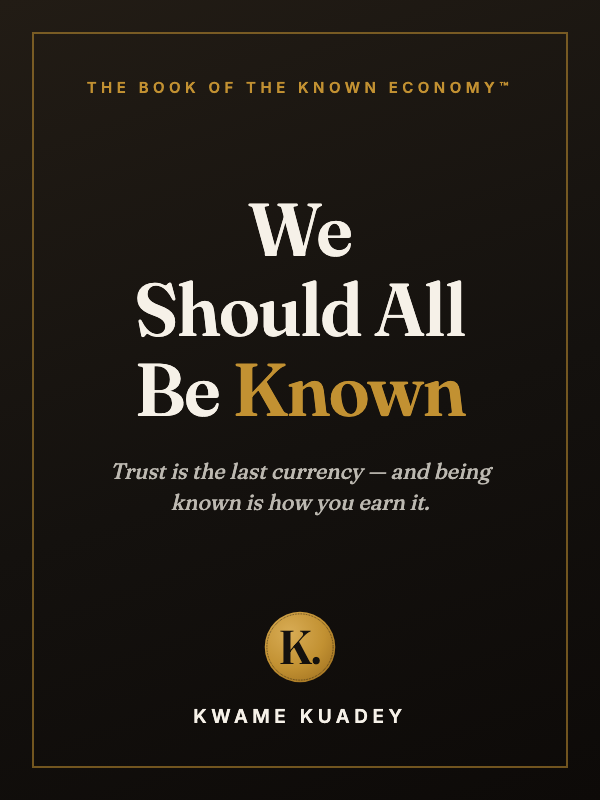
We Should All Be Known
The manifesto and the method for the Known Economy — how to become known, credible, and impossible to fake, so you can launch, pivot, pursue a passion, or make your name on a stage you actually own.
Gary Vaynerchuk was right — attention was the currency. But attention is infinite now, and most of it is fake. When a machine can manufacture attention, talent, faces, even emotion, attention stops being the moat. The last currency left is being known.
Content, talent, and even emotion can be manufactured infinitely now. So attention became cheap — and trust became scarce. People don't ask "is this good?" anymore. They've been burned too many times. They ask one thing first: is this real, and can I trust the human behind it?
Win by being seen. Reach is the asset. The loudest, most optimized, most viral wins — and the machine now wins that fight every time.
Win by being trusted. Being a real, credible, verifiably human person is the asset — because it's the one thing AI can't counterfeit.
The emerging era in which trust is the scarcest resource, and being a credible, verifiably human person is the only currency that still clears.
For a decade we lived in the attention economy — the game was reach. AI ended that game. Content, talent, faces, and even emotion can now be manufactured infinitely, so attention has become cheap and trust has become scarce.
We lost the ability to be moved without checking first. The reaction that used to be automatic — believe it, feel it, share it — now runs through a filter: is this real? Until that clears, people hold their emotion back on purpose. People vet before they feel now. It's self-defense.
That's the Known Economy. In it, you don't win by being the best-kept secret with the best work. You win by being known.
We should all be known — because being known is the only thing that earns you a stage to stand on, credibly.
Why trust now comes before talent — and what to do about it.
The content, the credentials, the badges, the face, the feeling. When anything can be manufactured, nothing is believed on sight.
Audiences now run silent due diligence before they let themselves connect. Trust is the gate. No trust, no attention, no sale.
A known, credible human is the one asset AI can't counterfeit. It's what lets you launch, pivot, start, and be believed.
You've felt it. That flinch before you let yourself believe something online — because if it's too good to be true, it probably is AI.
The New York Times found hundreds of AI-generated "doctors," healers, and wellness influencers selling supplements — complete with fake diplomas on the walls of fake offices, many aimed at older women.
A white coat, a framed "degree" on the wall, a verified badge on the channel — the markers we use to grant authority are now trivial to fake. That doctor on your feed may have no office, no diploma, and no pulse.
One overseas agency told the Times it produces around 1,200 AI ad videos a day at about $10 each. There's no federal law limiting synthetic people in advertising — the fakery scales faster than anyone can police it.
Before people let themselves react, they scroll to the comments — not to engage, but to see if anyone's already called it AI. They're crowdsourcing the vetting, because they don't have a source they trust.
Reporting: The New York Times — "The Fake Influencers Selling Wellness on Your Feed."
If you're the trusted human — if you have a place people know to come and find you — they don't have to vet you. You're pre-vetted. In an era where everyone else gets the flinch, the known get the benefit of the doubt.
And every time they come back and it's really you, the trust compounds.
That's the flywheel: be known, own the place people come to, and earn belief on arrival — every single time. It's why this whole page ends where it does — with a place to belong.
The manifesto and the method for the Known Economy — how to become known, credible, and impossible to fake, so you can launch, pivot, pursue a passion, or make your name on a stage you actually own.
One list. Two things: the ideas that define the Known Economy, and first access to We Should All Be Known. No noise.